

In many companies, reports from the marketing department and strategy papers from the board seem to live on different planets. Marketing reports clicks, impressions and "engagement", while the board stares at operating margins, market share and churn.
If these two worlds aren't aligned, marketing remains a disconnected activity – or an expense item that produces colourful slide decks but whose real impact on business growth is hard to prove.
It's time to put marketing at the heart of your business. Marketing is not just advertising; it is the most important business development unit of a company. But for it to fulfil its role, target setting needs to change.
Why are "vanity metrics" a manager's worst enemy?
We all love green arrows on reports. A 20% increase in website traffic seems great, but if that traffic doesn't convert into revenue, it doesn't really matter.
Indeed, the worst enemy of a B2B leader is vanity metrics. Numbers that look good, but tell you nothing about business impact. If marketing only reports clicks and the number of campaigns, everyone loses touch with what really brings in the money.
The solution is to move from reporting performance to analysing impact. Instead of "100 leads per month", the goal should be "reduce sales cycle time by 15%" or "increase market share in selected segment". Once the target is linked to the business, marketing can start to take responsibility for the result.
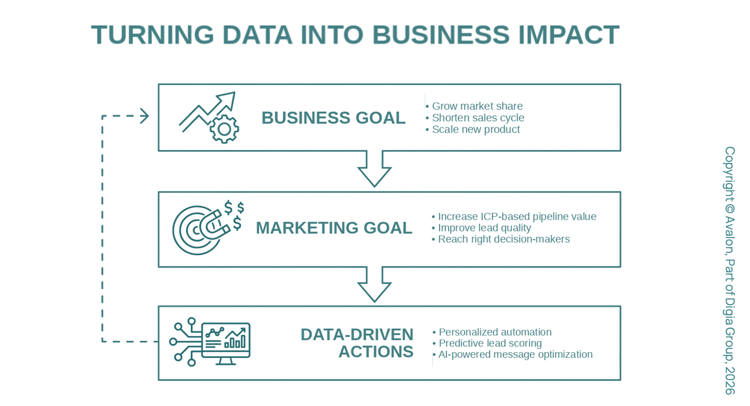
The three-step model: how to translate objectives from strategy into action.
How to put this change into practice? It requires a seamless interplay of strategy, data and technology.
1. Strategic alignment
You can't measure everything, and it's not worth doing everything at once. Business development starts with identifying the most critical bottlenecks. Is the problem new customer acquisition, or is revenue flowing away as customers leave? Once a strategic choice has been made, marketing is harnessed to solve this very problem.
2. Measurement infrastructure
Targets are just aspirations if they cannot be measured. This is where data and automation ecosystems come in. You need visibility across the entire purchase path from CRM to website to closing the deal. Only when data flows unimpeded will you understand which marketing investments generate returns and which are being wasted.
3. Continuous optimisation
AI and analytics enable on-the-fly directional adjustments. If the data tells you that a particular message isn't resonating with your target audience, AI can help shape a new angle in seconds. The strategy remains the same, but the execution must live with the data.
When the goal changes everything
Imagine a B2B company that wanted to increase its sales by 20%. Traditionally, marketing would have started by buying more ad space and generating generic leads.
This time, however, the company decided to focus on the quality of the business. The target was set as "Ideal Customer Profile (ICP) based sales pipeline value". Marketing stopped courting the masses and focused only on the most suitable customers, using accurate data and personalised automation.
The result? The number of leads dropped, but their quality rose so high that sales progressed through the pipeline at record speed. Marketing became sales' best friend and the engine of business growth.
Ask these questions at your next meeting
If you want to make sure marketing is really contributing to business growth, include these questions in your next meeting with your marketing team or partner:
- "How will this campaign help us achieve [business objective X]?" If the answer is vague, the goal is not clear.
- "Do we have the technical capability to see how marketing spend translates into sales pipeline?" This reveals gaps in the data ecosystem.
- "How are we leveraging AI and automation to react faster to market changes?"
Marketing is an investment, not an expense
When it is tightly aligned with business objectives, marketing becomes one of the company's most effective engines of growth. But it requires putting data at the centre and having the courage to measure things that directly impact the bottom line.
Want to spar about how to more tightly link your marketing goals and actions to your business growth? At Avalon, we help build a seamless connection between strategy, data and real results.
Contact us and together we'll see how we can make marketing the strongest growth driver for your business.